
BioBasicsBench is the test that finally asks AI the question every working scientist cares about: can you actually read a real experiment? On 6 November 2026, OpenAI released the 100-task benchmark, built with the enzyme-design company Ligo, to measure how well AI agents handle the messy, everyday evidence of wet-lab science — gel photos, colony plates, microscope images and instrument readouts, straight from the bench rather than cleaned up for a journal figure.
The headline result is striking. GPT-6 Astra earned 66.7% of the available credit at the highest reasoning setting, a huge jump from the 43.8% scored by GPT-5.6 Sol. Yet the same release shows the best model in the world picking the wrong colonies from a cloning gel, ignoring evidence that contradicted its own conclusion, and overcounting a petri dish by about 12%. In this guide, we explain what BioBasicsBench is, how it works, what the scores really mean, where AI improved, where it still fails, and what it tells us about trusting AI agents with real scientific work.
In this article:
- What Is BioBasicsBench?
- How BioBasicsBench Scores AI Agents
- BioBasicsBench Results: GPT-6 Astra Leads at 66.7%
- Where GPT-6 Astra Got Better
- Where BioBasicsBench Shows AI Still Fails
- What BioBasicsBench Means for Scientists and Everyone Else
- BioBasicsBench Limitations You Should Know
- What Happens Next for BioBasicsBench
- The Bottom Line
What Is BioBasicsBench?
BioBasicsBench is a 100-task benchmark that tests whether AI agents can interpret raw experimental evidence from routine wet-lab work. It was published by OpenAI on 6 November 2026 and developed with Ligo, a biotech company focused on enzyme design. Unlike most science benchmarks, which are built around charts and images selected for published papers, BioBasicsBench uses the unglamorous material scientists actually handle every day: failed experiments, ambiguous images, conflicting observations and the troubleshooting that follows.
That distinction matters. A published figure has already been through selection, cropping and annotation by a human who knew what the experiment showed. A raw gel photo or a plate-reader export has not. It contains smudges, uneven lighting, handwritten labels and results that do not fit the hypothesis. OpenAI’s own framing makes the point plainly: misreading an image or overlooking a problem with the controls used to check an experiment’s results can lead scientists to the wrong conclusion and waste time on experiments that will not answer their question.
The benchmark covers five areas of routine laboratory work. Protein methods make up the largest group with 25 tasks, followed by imaging and cytometry with 23, quantification and assays with 19, nucleic acid methods with 17, and molecular cloning with 16. The tasks range from simple requests, such as reading the molecular weight of a DNA sample in a gel, to detailed assay analysis — but all of them involve work that a wet-lab scientist should be able to complete reliably.
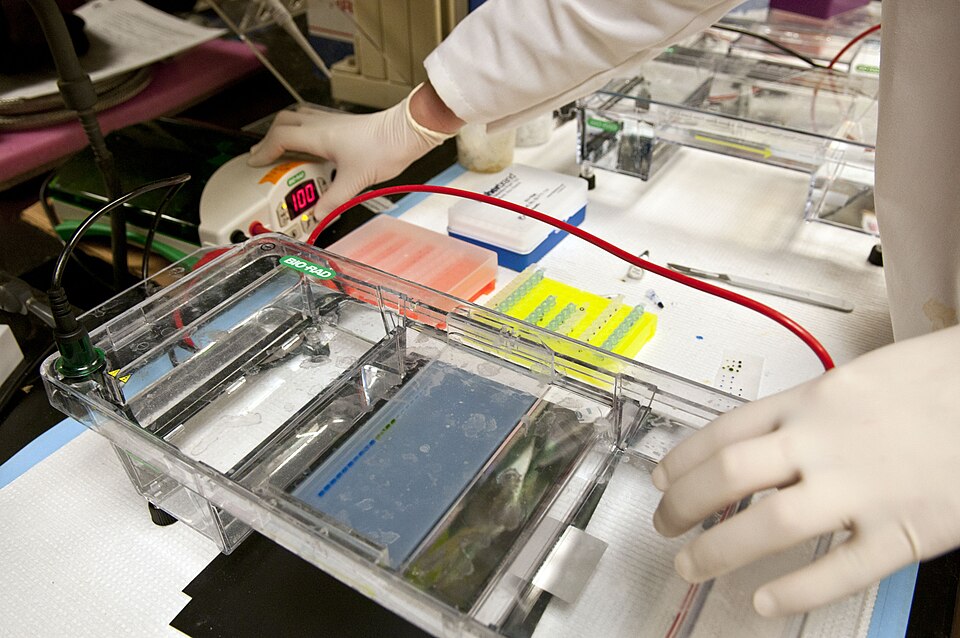
The evidence itself is deliberately varied. Gels and blots appear in 31 tasks, protocols and lab notes in 27, and spreadsheet or instrument exports in 20. Bench and apparatus photographs show up in 18 tasks, microscopy in 14, instrument screens and plots in 13, and sequencing files in 12. There are even seven tasks built around videos of bench work — streaking plates, inoculating cultures, serial dilution, setting up an SDS-PAGE tank — and seven built around agar plates and colonies. Reference sheets such as ladder charts and plasmid maps are supplied as supporting material in 21 tasks. A single task can include several kinds of data at once, which is exactly how real lab work presents itself.
Each task was built from data taken from a scientist’s own experiments, paired with a question and an expert-written grading rubric. Quality control was unusually thorough for a benchmark: every task passed an internal review by a Ligo scientist who had not written it, an external review by a PhD-level scientist working in a wet lab, and a final internal review. Reviewers checked the prompt, the experimental evidence, the rubric, the author notes and a graded model attempt before the task was accepted.
How BioBasicsBench Scores AI Agents
BioBasicsBench does not grade answers as simply right or wrong. Agents return a structured answer containing the requested conclusion, measurement or recommendation and, where required, supporting reasoning. Each answer earns credit against individual rubric criteria, so a correct conclusion with a wrong measurement scores differently from a wrong conclusion, and a well-reasoned answer that recognises the evidence is insufficient can still earn credit.
That partial-credit design is central to what the benchmark measures. Depending on the task, the rubric criteria assess the conclusion, the numerical results, the supporting reasoning, or the recognition that the evidence is insufficient. Nineteen of the 100 tasks specifically test whether the agent can say the evidence is not enough — a skill that matters enormously in a laboratory, where a confident answer built on inadequate data can send a whole project down the wrong path.
The skills tested cut across the five lab areas in a revealing pattern. Tacit knowledge — the unwritten know-how that experienced scientists carry in their heads — is tested in 88 of the 100 tasks. Image and data reading is tested in another 88. Error detection appears in 68 tasks, protocol understanding in 50, and spotting insufficient data in 19. One task can test several skills at once, so the columns do not add up to 100 — but the balance shows what BioBasicsBench is really about. It is not a test of textbook biology. It is a test of judgement: reading messy evidence, catching mistakes, understanding the procedure, and knowing when to stop.
OpenAI reports the headline figure as mean reward: the average task score, expressed as a percentage of the available credit. That detail is worth understanding before anyone quotes the numbers. A mean reward of 66.7% does not mean the model solved exactly 66.7 of the 100 tasks, because a task can award credit for some parts of an answer even when another part is wrong. It also does not mean there is a 66.7% chance that any given lab decision is correct. It is a graded average across expert rubrics, and OpenAI reports 95% confidence intervals calculated by resampling whole tasks, keeping the five attempts for each task together.
The evaluation itself was large. OpenAI ran seven of its own models across 37 model-and-reasoning-effort settings, with five attempts on each of the 100 tasks per setting, producing 18,500 graded results. That scale gives the comparisons real weight — but it also has a boundary that readers should keep in mind, which we cover in the limitations section below.
BioBasicsBench Results: GPT-6 Astra Leads at 66.7%
At the xhigh reasoning setting — the highest effort level reported for all seven models — GPT-6 Astra earned 66.7% of the available credit, with a 95% confidence interval of 60.3% to 73.1%. The next model, GPT-6.1 Sol, scored 62.0% (55.6–68.4%). Then comes a steep drop: GPT-5.6 Sol managed 43.8% (37.6–50.0%), GPT-6 Luna 38.3% (32.3–44.5%), GPT-5.5 35.4% (29.7–41.0%), GPT-5.4 33.2% (28.3–38.4%) and GPT-5.2 31.2% (26.2–36.3%).
Three things stand out in that table. First, the jump from GPT-5.6 Sol is real. Astra’s confidence interval (60.3–73.1%) does not overlap Sol’s (37.6–50.0%), so the 22.9-percentage-point improvement is not statistical noise. Second, Astra and GPT-6.1 Sol are close: their intervals overlap heavily, so the 4.7-point gap at the top is not a clear win for Astra. Third, and most interestingly, the better answers came from less writing. Astra averaged 4,704 output tokens per task — about half of GPT-5.6 Sol’s 9,099 and roughly a sixth of GPT-5.2’s 27,620. OpenAI’s reading is that stronger native multimodal capabilities may be the key to improving performance on everyday wet-lab analysis. In plain terms, seeing the image better beat thinking about it longer.
OpenAI also notes that Astra improved substantially on GPT-5.6 Sol even at low reasoning effort, which supports the same conclusion: the gain comes from how the model reads images and other raw evidence, not from simply spending more tokens on reasoning. That is a meaningful shift in how we should think about AI progress in science. For years, the story was that more reasoning time meant better answers. BioBasicsBench suggests that for laboratory evidence, better seeing matters at least as much as better thinking.
The Full BioBasicsBench Score Table at Xhigh Reasoning Effort
| Model | Mean reward | 95% confidence interval | Output tokens per task |
|---|---|---|---|
| GPT-6 Astra | 66.7% | 60.3–73.1% | 4,704 |
| GPT-6.1 Sol | 62.0% | 55.6–68.4% | 5,238 |
| GPT-5.6 Sol | 43.8% | 37.6–50.0% | 9,099 |
| GPT-6 Luna | 38.3% | 32.3–44.5% | 13,120 |
| GPT-5.5 | 35.4% | 29.7–41.0% | 11,135 |
| GPT-5.4 | 33.2% | 28.3–38.4% | 13,717 |
| GPT-5.2 | 31.2% | 26.2–36.3% | 27,620 |
One surprise in the table deserves attention: GPT-6 Luna scored lower than GPT-5.6 Sol, despite being a newer model. Luna is OpenAI’s efficient everyday model, designed for speed and cost rather than maximum capability — and BioBasicsBench shows exactly where that trade-off bites. Routine wet-lab analysis turns out to be one of the tasks where the efficient model struggles. Readers who want the full picture on Luna can read our GPT-6 Luna explained guide, and our GPT-6.2 explained article covers the newest models in the family. For the mid-tier model that nearly matched Astra, see our GPT-6.1 Sol explained guide.
Where GPT-6 Astra Got Better
The score alone does not tell the story. OpenAI walks through three cases where GPT-5.6 Sol went wrong and Astra did not, and each one shows a different kind of improvement.
It knew what the data could not show. In one task, Sol classified cells as dead because they glowed in the channel for a dead-cell dye. The problem is that the detector window for that dye (470–540 nm) overlaps the window of a second dye (525–580 nm) at 525–540 nm, so brightness alone proved nothing — the signal could have come from either dye. Astra flagged the overlap and asked for better controls to separate the signals. This is exactly the kind of restraint that matters in a lab: not drawing a conclusion the evidence cannot support. It is also the skill that 19 tasks in the benchmark test directly.
It read the label on the plate. In a DNA cloning experiment, Sol saw no colonies on the negative-control plate and treated the experiment as clean. Astra noticed the rim label read “LB Kan50” — a kanamycin plate — while the experiment used ampicillin, and rejected the plate as a valid control. A control that was never actually a control would have let a flawed experiment pass. Catching a mislabelled plate is the kind of detail that separates a careful scientist from a careless one, and it is precisely the kind of detail an AI that only reads the centre of an image would miss.
It kept the context in mind. Shown cells fading in and out across a series of microscope frames, Sol looked for a biological reason for the cells’ apparent disappearance. Astra recognised a z-stack — the same cells imaged at different depths — and understood that the fading was an artefact of the imaging, not a biological event. Holding experimental context in mind while analysing data is one of the tacit-knowledge skills the benchmark tests in 88 of its 100 tasks, and this example shows why it matters.
Together, these three wins paint a consistent picture. Astra is better at reading images in fine detail, better at noticing the small pieces of evidence that change an interpretation, and better at holding the experimental context steady while it reasons. Those are the abilities that produced the jump from 43.8% to 66.7% — and they are the abilities that any AI agent will need before scientists can trust it with real bench work.
Where BioBasicsBench Shows AI Still Fails
The failure cases are the most instructive part of the release, because each one is a mistake a careful scientist would not make. OpenAI is unusually candid here, and its own summary is worth quoting: “Higher benchmark scores do not yet mean models can make reliable judgments in the lab.”
An assumption beat the controls. On a colony PCR gel, Astra sorted the bands into the right two groups but assumed the larger PCR product meant successful cloning. It picked lanes 4, 6, 7 and 8; the controls point to lanes 5, 9 and 10. The visual grouping was correct, but the experimental identities attached to those groups were reversed relative to the reference. Following that answer would mean purifying the wrong plasmid — real time, real reagents and a real dead end. The model did the hard visual work correctly and then let a familiar assumption override what the controls actually said.
It discarded evidence that did not fit. Astra concluded that vacuoles — compartments inside cells — look darker than the surrounding cell, even though lighter vacuoles were visible in the same image. The model had itself noted that contrast changes with focus, and that both appearances occur because different focal depths can reverse the contrast. Yet it gave greater weight to the cells it called better focused and kept only their darker-vacuole description in the final answer. The contradictory lighter regions had been inspected but were not considered in the conclusion. This is a classic failure mode: the model formed a preferred interpretation and quietly dropped the evidence against it.
It miscounted a plate. Astra merged close neighbours, missed visible colonies and marked empty agar, producing a net overcount of approximately 12% relative to the benchmark reference. That sounds small until you follow the arithmetic. Transformation efficiency — the measure of how efficiently DNA was introduced into cells — is calculated from that count, so with the plated volume and dilution held fixed, the efficiency estimate is inflated by the same 12%. A 12% error in a routine count becomes a 12% error in a result that a scientist might report, publish or build a decision on.
These three failures share a pattern. None of them is a simple factual error. Each one is a judgement error: trusting an assumption over a control, favouring a preferred interpretation over contradictory evidence, or counting carelessly. That is why the benchmark matters — and why its headline score, impressive as it is, should not be mistaken for readiness.
What BioBasicsBench Means for Scientists and Everyone Else
BioBasicsBench is a biology test, but the pattern it exposes applies to any AI agent that reads real-world evidence at work: invoices, dashboards, contracts, screenshots, medical images, legal documents. The costly error is rarely a wrong fact. It is a confident conclusion built on a check that was never valid — the wrong control plate, a mislabelled column, a stale field, a dye channel that overlaps another. A benchmark that grades “recognise when the evidence cannot support a conclusion” as its own skill is measuring the right thing, and even the best model here earns two thirds of the credit.
For scientists, the practical lesson is about how to use these tools today. The sensible workflow is the one OpenAI’s own examples imply: let the agent do the first read and draft the analysis, and keep the judgement call on controls and conclusions with the scientist. An agent that reads a gel in seconds and flags the interesting lanes is genuinely useful. An agent that picks which colonies to purify without a human checking the controls is a risk. The 66.7% score tells us the first use is getting close to reliable; the failure cases tell us the second is not.
For anyone building or buying AI agents, BioBasicsBench is a reminder to test on your own messy data, not on clean demo material. A model that scores well on polished benchmark figures can still stumble on the unpolished evidence your team actually handles. Ask vendors how their agents perform on raw, unselected inputs — and how they behave when the evidence is insufficient, not just when it is clear.
There is also a wider implication that OpenAI flags explicitly: tracking these capabilities will help researchers understand their implications for biosafety and biosecurity. As AI gets better at reading and reasoning about biological experiments, the same capabilities that accelerate legitimate research could, in the wrong hands, lower the barrier to harmful work. Measuring progress is the first step to governing it responsibly.
BioBasicsBench Limitations You Should Know
A fair reading of BioBasicsBench requires honesty about what it does not establish. Four limitations matter most.
Only OpenAI’s own models were tested. The evaluation covered seven OpenAI models and no others. There are no Claude, Gemini or open-weight scores on BioBasicsBench yet, so the benchmark cannot currently tell us how the best models from other labs compare. That also means the headline improvement is a comparison within one company’s product line, not a statement about the state of the field.
There is no independent replication yet. The announcement does not say whether the 100 tasks will be released for others to run, and Ligo, the co-developer, also supplied the data. Until outside researchers can run the same tasks and inspect the rubrics, the 66.7% figure should be read as a provider-reported signal of progress, not as a universal certificate that an agent is laboratory-ready. The private task set is a real constraint on verification.
One hundred tasks cannot represent every laboratory. The tasks cover five areas of routine work, but they cannot represent every instrument, sample, experimental context or decision a laboratory might face. The confidence intervals quantify uncertainty in this benchmark sample, not performance across every laboratory and instrument in the world.
A higher rubric score is not evidence of better real-world outcomes. BioBasicsBench measures graded answers against expert rubrics. It does not measure whether using an agent actually improves results at the bench, saves time without introducing errors, or changes what a scientist decides to do next. OpenAI says as much itself — and it is the most important caveat in the whole release.
None of this invalidates the reported improvement. A 22.9-percentage-point jump with non-overlapping confidence intervals is a real signal. But it is a signal about performance on one benchmark, measured by the company that built both the benchmark and the model. Treat it as the beginning of an evidence base, not the end of one.
What Happens Next for BioBasicsBench
The most useful next step would be publication of the task set, so other labs can be scored on the same 100 tasks. The first non-OpenAI results — especially from Claude and Gemini models with strong image reading — would turn BioBasicsBench from a single-company progress report into a field-wide yardstick. Watch, too, for follow-up work on the specific failure modes: control checking, colony counting and handling contradictory evidence are the three areas where even the best model still stumbles, and they are the areas where the next generation of models will be judged.
There is also a broader question the benchmark raises for the whole AI industry. If the lesson of BioBasicsBench is that better image reading beats longer reasoning, then the next wave of progress in scientific AI may come from multimodal capability rather than from scaling reasoning effort. That has implications for how labs choose models, how vendors price them, and how researchers design the next generation of evaluations. For readers following the frontier-model race, our GPT-6 Cyber explained guide covers another GPT-6 model built for a specialised domain — in that case, cybersecurity — and shows the same pattern of models being tuned for specific professional work.
Finally, watch for BioBasicsBench-style evaluations spreading beyond biology. The same design — raw evidence, expert rubrics, partial credit, and tasks that test whether the agent knows when to say it does not know — could be applied to chemistry, materials science, clinical data and engineering. The wet lab is where OpenAI started. It is unlikely to be where this kind of testing stops.
The Bottom Line
BioBasicsBench shows that AI agents have made a genuine leap in reading real laboratory evidence — and that they are still not ready to be trusted with the judgement calls. GPT-6 Astra’s 66.7% is a substantial improvement on GPT-5.6 Sol’s 43.8%, achieved with about half the output tokens, and the improvement comes from better image reading rather than longer reasoning. The model catches mislabelled controls, flags overlapping dye channels and recognises a z-stack where its predecessor saw disappearing cells.
But the same model picks the wrong colonies from a cloning gel, discards evidence that contradicts its preferred interpretation, and overcounts a plate by 12%. Those are not trivia. They are the exact mistakes that waste a scientist’s week. Until a model can check its own controls, weigh contradictory evidence and count carefully, the right role for an AI agent in the lab is as a fast first reader — with a human scientist keeping the final call.
That is the honest meaning of BioBasicsBench. It is not a pass mark for AI in science. It is a map of how far the field has come and how far it still has to go — and it is a better map than anything that came before it, because it tests the work scientists actually do, in the form they actually do it.
Frequently Asked Questions
What is BioBasicsBench?
BioBasicsBench is a 100-task benchmark from OpenAI and Ligo, published on 6 November 2026, that tests whether AI agents can interpret raw evidence from routine wet-lab science, identify errors and recognise when the evidence cannot support a conclusion.
What did GPT-6 Astra score on BioBasicsBench?
GPT-6 Astra earned 66.7% of the available credit at the xhigh reasoning setting, with a 95% confidence interval of 60.3–73.1%. GPT-6.1 Sol scored 62.0% and GPT-5.6 Sol scored 43.8% at the same setting.
Does a 66.7% BioBasicsBench score mean AI is ready for the lab?
No. OpenAI itself says higher benchmark scores do not yet mean models can make reliable judgements in the lab. Astra still picked the wrong colonies from a cloning gel, discounted contradictory evidence and overcounted a plate by about 12%.
Which models were tested on BioBasicsBench?
Seven OpenAI models: GPT-5.2, GPT-5.4, GPT-5.5, GPT-5.6 Sol, GPT-6.1 Sol, GPT-6 Luna and GPT-6 Astra, across 37 model-and-reasoning-effort settings with five attempts per task — 18,500 graded results in total. No Claude, Gemini or open-weight models have been tested yet.
Where can I read the original BioBasicsBench announcement?
OpenAI published the full results in Measuring how AI agents handle everyday wet-lab science. A detailed independent walkthrough is available at Unite.AI.