
LingBot-VLA 2.0 Explained: Ant Group’s Free Open-Source Robot Brain
On 4 November 2026, Ant Group’s robotics unit Robbyant stood on stage at the World Internet Conference in Wuzhen and made a claim that would have sounded like science fiction five years ago: a single free AI model can now drive twenty different kinds of robot, from single-arm factory rigs to full humanoids, and robots running it are already picking medicines off pharmacy shelves in Shanghai during normal trading hours. That model is LingBot-VLA 2.0, and if you build robots, study them, or simply want to understand where physical AI is heading, it is one of the most important open releases of the year.
LingBot-VLA 2.0 is a vision-language-action model — a VLA — which means it takes in what a robot’s cameras see and a plain-language instruction such as “put the red box in the fridge”, and turns that into the physical movements a robot needs to do the job. The 6-billion-parameter model is fully open-sourced under the permissive Apache 2.0 licence, with its weights, code and technical report all public. In this guide, we explain what LingBot-VLA 2.0 actually is, how it works, what its benchmarks really prove, how the full LingBot 2.0 family fits together, and how you can download and run it yourself.
Before we go further, one honest note that applies to almost every number in this article: the headline figures — the 60,000 hours of training data, the 130-millisecond response time, the benchmark wins — come from Robbyant’s own team and its technical report. No independent third party has publicly re-run the benchmarks yet. We flag that wherever it matters, because a smart reader should know the difference between a vendor’s claim and a verified fact.
Table of Contents
- What Is LingBot-VLA 2.0?
- How LingBot-VLA 2.0 Works
- The 60,000 Hours of Training Data Behind It
- Benchmarks: What LingBot-VLA 2.0 Can Actually Do
- The Full LingBot 2.0 Stack: Six Models, One System
- Real-World Use: Robots in Shanghai Pharmacies
- How to Download and Run LingBot-VLA 2.0
- LingBot-VLA 2.0 vs NVIDIA GR00T and pi0.5
- Limitations and Honest Caveats
- What LingBot-VLA 2.0 Means for the Future of Robotics
- Frequently Asked Questions
What Is LingBot-VLA 2.0?
LingBot-VLA 2.0 is a general-purpose robot policy: one trained model that can control many different robot bodies. It was released on 8 July 2026 by Robbyant, the embodied-AI company inside Ant Group — the same group behind Alipay — and it builds on LingBot-VLA 1.0, which Robbyant open-sourced in January 2026. The “VLA” in the name stands for vision-language-action, the three ingredients of the model: it sees through cameras, understands language instructions, and outputs actions.
The simplest way to think about it is as a robot’s brain in a downloadable file. Traditional industrial robots are programmed task by task: an engineer writes precise instructions for one machine doing one job in one fixed environment. Change the object, move the shelf, or swap in a different robot arm, and the program breaks. A VLA model works differently. You show it the scene, you tell it what you want in ordinary words, and it figures out the movements itself — including on robot hardware it was never specifically programmed for.
That last point is what makes LingBot-VLA 2.0 interesting. According to Robbyant, the same trained policy runs on twenty robot configurations from seventeen manufacturers without retraining for each platform. The list spans Leju, AgiBot, Unitree, AgileX, Galaxea, Galbot, Astribot, RealMan, Franka, ARX, X-Humanoid, Fourier, MagicLab, Spirit AI, Zerith, Flexiv and Qinglong — a mix of Chinese humanoid startups, established arm makers and research platforms. If that cross-embodiment claim holds up in independent testing, it solves one of robotics’ oldest problems: every robot body has historically needed its own software brain.
Why the Wuzhen Announcement Matters
The model itself is not brand new — it has been public since July. What is new is the moment around it. On 4 November 2026, Robbyant presented the complete LingBot 2.0 family at the World Internet Conference in Wuzhen, and Ant Group reported that the LingBot family has now passed 2.2 million downloads and 33,000 GitHub stars in nine months. Those are Ant’s own figures, but the scale is striking for a robotics model: most research models never leave the lab, let alone get downloaded two million times.
The Wuzhen presentation also reframed LingBot-VLA 2.0 as one piece of a larger system rather than a standalone model. Alongside it, Robbyant showed LingBot-Vision and LingBot-Depth for perception, LingBot-Video and LingBot-World for modelling how the world behaves, and LingBot-VA as a fast action model. The pitch is a single stack that takes a robot from seeing its environment to predicting what will happen next to acting on it — and every piece of it is open. We break the full stack down in a later section.
Who Is Robbyant?
Robbyant is Ant Group’s dedicated embodied-intelligence company, focused on the software side of robotics rather than building its own hardware. That positioning matters: because Robbyant does not sell a robot of its own, its business case depends on its models running well on other companies’ machines. Open-sourcing the weights is not charity — it is a strategy to make LingBot the default brain that hardware makers build around, much as Android became the default operating system for phone makers that did not want to build their own.
The company says its work has already been cited by Physical Intelligence and Generalist AI, two of the most-watched robotics labs, and that Stanford’s OpenWAM project adapted its LingBot-VA module. A Korean research project called FastOPD has used LingBot-VLA as a teacher model to train lighter policies, and EPFL in Switzerland has used LingBot-Map to reconstruct coral reefs in 3D. These are early academic signals, not proof of dominance, but they suggest the release is being taken seriously beyond Ant’s own orbit.
How LingBot-VLA 2.0 Works
At its core, LingBot-VLA 2.0 follows the now-standard recipe for vision-language-action models, with a few practical twists that Robbyant says make it better suited to real deployment. Understanding the recipe helps you judge the claims that follow.
The Vision-Language Backbone
The public model, lingbot-vla-v2-6b, is a 6-billion-parameter checkpoint built on Qwen3-VL-4B-Instruct, Alibaba’s vision-language model, as its backbone. That choice is itself informative: rather than training a robot brain from scratch, Robbyant started from a model that already understands images and language well, then taught it to produce robot actions. Two teacher models supervised the training through distillation — LingBot-Depth, which adds spatial depth understanding, and DINO-Video, which adds understanding of motion over time. The result is what Robbyant calls a “native depth” checkpoint: the model does not just see a flat picture, it has a sense of how far away things are and how they move.
In practice, one inference call works like this. The robot’s cameras capture the scene, the operator (or a higher-level planner) gives a language instruction, and the model outputs a chunk of actions — joint movements, gripper commands, base motion — for the robot to execute. It then observes the result and repeats the loop. Because the model was trained on huge amounts of real manipulation data, it can generalise to objects, layouts and instructions it has never seen in exactly that combination before.
Whole-Body Control: Head, Waist, Hands and Wheels
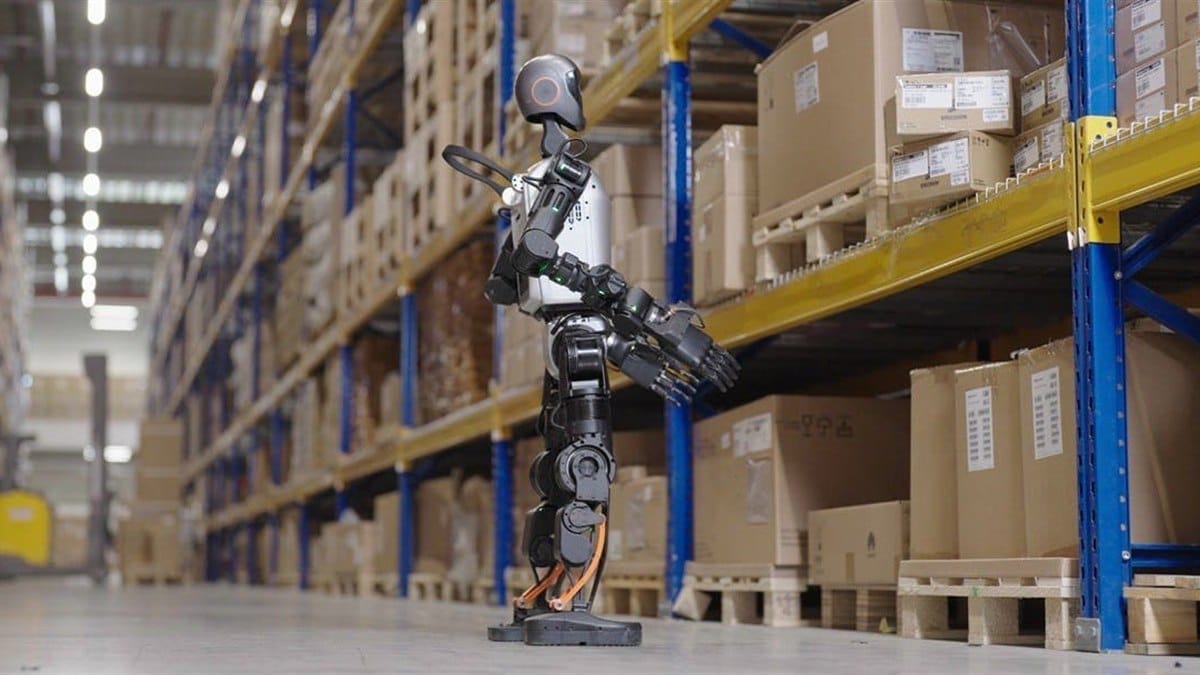
Most earlier VLA models controlled a pair of arms and stopped there. LingBot-VLA 2.0 extends its action space to the whole robot: the head, the waist, the end-effectors (hands or grippers), and the mobile chassis underneath. That matters more than it sounds. A robot picking an item from a low shelf needs to bend its waist and tilt its head to see what it is doing; a mobile manipulator needs to drive its base into position before its arms can reach.
Controlling those degrees of freedom together, in one model, is what lets a humanoid walk up to a shelf, look at it, reach for the right box and carry it away as one continuous behaviour rather than a series of separately programmed steps.
This whole-body capability is also what makes the pharmacy deployment possible. The robots working in Shanghai’s Guoda pharmacies operate in aisles just 80 centimetres wide, where a robot cannot afford to flail or take a second attempt at a grasp. Coordinated head, waist and base control is the difference between a demo that works in a lab and a machine that can operate in a real shop.
Speed: About 130 Milliseconds per Decision
Robots cannot think slowly. A model that takes two seconds to decide what to do next will drop things, overshoot, or freeze mid-task. Robbyant reports that one inference call from LingBot-VLA 2.0 takes about 130 milliseconds on a single NVIDIA GeForce RTX 4090D graphics card, using ten denoising steps. A post-training optimised version pushes latency under that 130ms mark.
That figure deserves context. 130 milliseconds is roughly the time of a human blink — fast enough for smooth, continuous manipulation, and achieved on a consumer gaming GPU rather than a data-centre rack. It means a research lab or a small robotics company can plausibly run the model on hardware they already own, which is a big part of why the release has travelled so far. The caveat, as always, is that this is Robbyant’s own measurement on its own setup; your latency will depend on your hardware, your camera pipeline and how many denoising steps you run.
The 60,000 Hours of Training Data Behind It
If there is one number that explains LingBot-VLA 2.0, it is 60,000 hours. That is how much real-world physical data Robbyant says the model was pre-trained on — and the composition of that data is more interesting than the total.
50,000 Hours of Robots Doing Real Work
The bulk of the training set, about 50,000 hours, is robot trajectory data: recordings of real robots performing real manipulation tasks across twenty configurations. This is not simulation. Simulated data is cheap and plentiful, but robots trained only in simulation tend to fail the moment they meet the real world’s friction, lighting changes and imperfect grasps. Real trajectory data is expensive to collect — every hour represents a physical robot, in a physical space, doing a physical job — which is why 50,000 hours is a serious moat. It is also why Ant Group’s resources matter: few organisations can afford to run that much robot time.
The twenty configurations matter as much as the hours. Training across single-arm rigs, dual-arm setups, mobile manipulators and full humanoids forces the model to learn manipulation in general rather than memorising one machine’s quirks. When a model has only ever seen one arm, it learns that arm. When it has seen twenty bodies, it has to learn the underlying skill — how to approach, grasp, lift and place — in a form that transfers.
10,000 Hours of Humans, Seen From the First Person
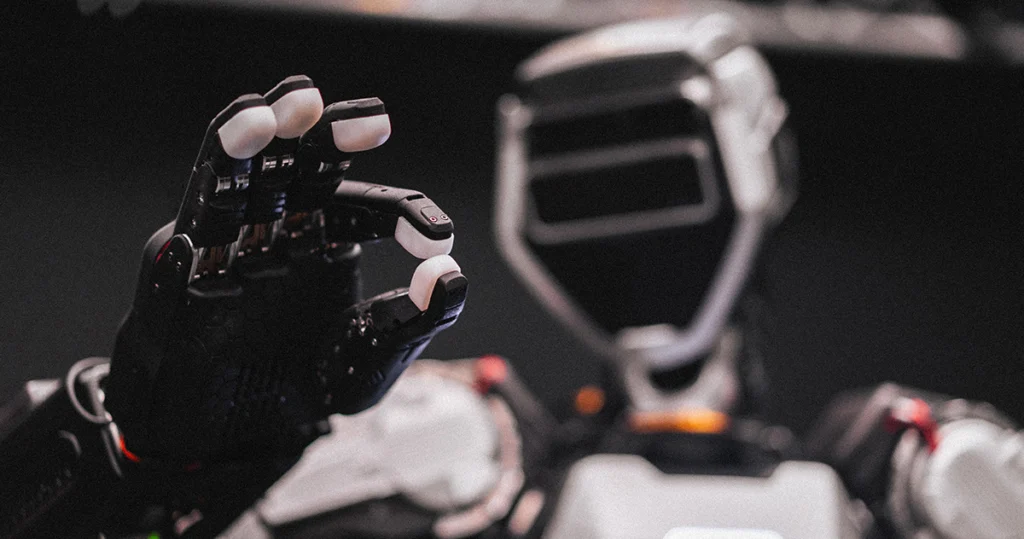
The remaining 10,000 hours are egocentric human video: first-person footage of people doing manipulation tasks with their own hands. This is a clever shortcut. Human demonstrations are far easier to collect at scale than robot demonstrations — anyone with a head-mounted camera can generate them — and they carry rich information about how manipulation actually works: how a hand approaches an object, how fingers close around it, how much force a task needs. Distilling that human knowledge into a robot policy is one of the more promising ideas in embodied AI right now, and LingBot-VLA 2.0 is one of the largest public examples of it being done at scale.
There is a catch worth naming. Human hands and robot grippers are not the same, and a model can learn human-like strategies that a given robot body cannot execute. Robbyant’s answer is the mixture itself: the human video teaches the what and the why of manipulation, while the 50,000 hours of robot data teach the how for real hardware. Whether that transfer works as well as claimed is exactly what independent evaluation needs to test.
How the Data Was Cleaned
Raw robot data is messy. Cameras get occluded, operators make mistakes, trajectories fail halfway. Robbyant says its 50,000 hours are cleaned robot interaction data — the trajectories were filtered and curated rather than dumped in raw. The company has not published the full details of its cleaning pipeline, which is a genuine gap for researchers who want to reproduce the result. The technical report, published on arXiv as “From Foundation to Application: Improving VLA Models in Practice”, describes the training approach and the evaluation setup, and it is the best place to go if you want the detail that a news-style article cannot carry.
Benchmarks: What LingBot-VLA 2.0 Can Actually Do
Benchmarks are where robot models are most often oversold, so this section separates what Robbyant measured, what it claims, and what remains unproven.
The GM-100 Benchmark
Robbyant evaluates LingBot-VLA 2.0 in a generalist setting on GM-100, short for Great March 100, a bimanual manipulation benchmark developed at Shanghai Jiao Tong University. It tests a model across one hundred manipulation tasks that require two arms working together — the kind of coordinated work that is easy for people and hard for robots, from folding and packing to assembling and sorting.
On GM-100, Robbyant reports that LingBot-VLA 2.0 outperforms Physical Intelligence’s pi0.5 across multiple hardware classes. That is a bold claim, because pi0.5 is one of the most respected open robot models in the field. But it comes with the standard caveat: the scores were produced by Robbyant’s own team on its own evaluation pipeline, and no independent third-party replication has been published. Until another lab re-runs the comparison, treat “beats pi0.5” as a company claim, not a settled fact.
A Concrete Example: The Fridge Task
Abstract benchmark scores are hard to picture, so here is a concrete one from the published research. When an Astribot S1 robot was told to collect objects and place them inside a refrigerator under familiar conditions, LingBot-VLA 2.0 achieved a 60.0% task completion rate. That number is more honest than it looks: a 60% success rate on a multi-step household task is genuinely impressive for a generalist model, and it is also a long way from the reliability a real deployment needs.
The gap between 60% and the 99%+ a pharmacy or warehouse requires is the gap the field is now trying to close, and it is why Robbyant pairs the model with post-training and task-specific fine-tuning rather than promising it works perfectly out of the box.
Predictive Dynamics: Thinking Ahead
One of the three advances Robbyant highlights in version 2.0 is predictive dynamics modelling — the model does not just react to what it sees, it predicts how the scene will change as it acts. That is a meaningful step toward robots that can handle the unexpected: a box that slides, a bottle that tips, a drawer that sticks. The other two advances are generalisation (working on new objects and layouts) and the expanded action space (the whole-body control described above). Together, they are the reason Robbyant calls this a foundation model for robots rather than a task-specific policy.
What the Numbers Do Not Show
Three things are missing from the public evidence so far. First, independent replication: nobody outside Robbyant has published a head-to-head re-run of the GM-100 comparison. Second, long-horizon reliability: benchmarks measure short tasks, not eight-hour shifts in a real shop. Third, failure modes: the technical report says little about how the model fails — whether it drops things, misreads instructions, or freezes — and failure modes are what operators actually need to plan around. None of this makes the model bad; it makes it early. Every open model goes through this phase, and LingBot-VLA 2.0’s openness is precisely what lets the wider community do the verification.
The Full LingBot 2.0 Stack: Six Models, One System
LingBot-VLA 2.0 is the action half of a bigger idea. At Wuzhen, Robbyant presented six models as one embodied-native system, organised into three layers: perception, world modelling, and action.
Perception — LingBot-Vision and LingBot-Depth. These models handle seeing and understanding space. LingBot-Vision interprets what the cameras capture; LingBot-Depth adds the three-dimensional geometry — how far away each surface is. Notably, LingBot-Vision has been merged into the main branch of timm, the widely used open-source vision library, which is a strong signal that the broader computer-vision community finds it useful beyond robotics.
World models — LingBot-Video and LingBot-World. These models predict what happens next. LingBot-Video generates video of possible futures; LingBot-World is a real-time world model that a robot can use to plan. LingBot-World runs on both vLLM and SGLang, the two leading open inference engines, and NVIDIA has integrated it into FlashDreams, its open-source world-model library. If a robot can simulate the outcome of its actions before taking them, it can avoid the mistakes that a purely reactive model makes.
Action — LingBot-VLA and LingBot-VA. LingBot-VLA 2.0 is the deliberate, generalist policy described in this article. LingBot-VA 2.0 is its faster sibling — a video-action model built for speed, which Robbyant describes as the capstone of the system. The two are designed to work together: VLA for considered, general manipulation and VA where low latency matters most.
The design goal, in Robbyant’s words, is one model reused across different robot bodies and tasks instead of training a separate brain for each machine. That is the same logic that made foundation models transformative in language and images: train once, at scale, then adapt cheaply. Whether it works as well for bodies as it did for words is the open question the whole embodied-AI field is now testing — and LingBot is one of the largest public bets on the answer being yes.
The stack is also unusually well connected to the open ecosystem. LingBot-VLA and LingBot-VA have been adapted to Hugging Face’s LeRobot platform, the standard open library for robot learning, which lowers the barrier for anyone who wants to try them. A RoboTwin post-trained checkpoint, robbyant/lingbot-vla-v2-6b-robotwin, is published alongside the base model for researchers working in simulation.
Real-World Use: Robots in Shanghai Pharmacies
The most concrete claim from the Wuzhen presentation is also the most interesting: robots running LingBot models are now picking medicines in Guoda pharmacies in Shanghai during regular trading hours. This is Ant’s claim of regular operation at several stores, and it matters because a pharmacy is a much harder environment than a lab.
Think about what a pharmacy robot has to do. The shelves are dense, the items are small and similarly packaged, the aisles are — by Ant’s own account — just 80 centimetres wide, and the cost of a mistake is not a dropped box but the wrong medicine. A robot working there needs reliable grasping, careful handling, and the ability to navigate a tight space shared with staff and customers. It also needs to keep working for a whole shift, not just for the length of a demo video.
That is why the pharmacy story, if it holds up, is a stronger signal than any benchmark. Benchmarks measure capability in controlled conditions; a pharmacy measures reliability in uncontrolled ones. Ant has also signed an agreement to explore retail and logistics uses in the Middle East, which suggests the pharmacy deployment is being treated inside the company as a template rather than a one-off showcase.
Two notes of caution. First, Ant has not published detailed operational figures — no uptime numbers, no error rates, no count of stores — so we cannot yet judge how well the deployment actually performs. Second, a pharmacy deployment in Shanghai does not automatically mean the same model is ready for a warehouse in Ohio or a hospital in Texas. Local integration, safety certification and support are separate problems from the model itself. Still, the direction is clear: LingBot has moved from a research release to something a business is willing to run in front of paying customers.
The Robbyant Embodied AI Challenge
There is another near-term test of the model coming up. The inaugural Robbyant Embodied AI Challenge, organised with ModelScope and Alibaba Cloud Tianchi, completed its online qualification stage on 27 October 2026, and finalists will move to Shanghai from 14–16 November to have their algorithms tested on physical robots in a hackathon. The competition centres on LingBot-VLA 2.0. Competitions like this are useful for everyone else, because they force models to perform on hardware the developers did not choose, in front of an audience — which is much harder to game than a self-reported benchmark.
How to Download and Run LingBot-VLA 2.0
One of the best things about LingBot-VLA 2.0 is that you do not need to take Robbyant’s word for any of this. The model is public, and the whole pipeline — weights, code, evaluation tools — is available to download. Here is what you need to know to get started.
Where to Get It
The official code lives on GitHub at github.com/Robbyant/lingbot-vla-v2, and the weights are on Hugging Face at huggingface.co/robbyant/lingbot-vla-v2-6b. The repository ships install scripts, model-download scripts, data-processing tooling, fine-tuning documentation and an automated evaluation harness for the GM-100 benchmark. A typical download command from the project’s own docs looks like this:
python3 scripts/download_hf_model.py --repo_id robbyant/lingbot-vla-v2-6b --local_dir lingbot-vla
The technical report, “From Foundation to Application: Improving VLA Models in Practice”, is published on arXiv and is worth reading before you run anything — it explains the training setup, the evaluation protocol and the model’s known limits in far more detail than any news coverage.
The Licence: Apache 2.0
This is the detail the leads file flagged for verification, and it checks out: both the codebase and the model checkpoint are released under Apache 2.0, the most permissive licence in widespread use. That means you can download the weights, run them on your own infrastructure, modify them, and deploy them commercially without negotiating a licence with Ant Group — and without any data flowing back to Ant. There is no non-commercial restriction on the weights, which sets LingBot-VLA 2.0 apart from several competing open models that limit commercial use. If you are building a product, that distinction is worth real money.
One practical note: Apache 2.0 covers the code and the weights as released. If you fine-tune the model on your own data, your fine-tuned version is yours; the usual Apache attribution requirements still apply to the original work. If you are in any doubt for a commercial deployment, have a lawyer glance at the licence file in the repository — it takes ten minutes and it is cheaper than being wrong.
What Hardware You Need
Robbyant’s reference number — about 130 milliseconds per inference call — was measured on an NVIDIA GeForce RTX 4090D, a high-end consumer card. That is the good news: you do not need a data-centre GPU to run the model. The more sobering news is that a 6-billion-parameter model with a vision backbone still needs a serious GPU with plenty of video memory, plus cameras, a robot to control, and the software glue to connect them. This is not a model you run on a laptop and point at a webcam for fun, though a well-equipped lab can absolutely get it moving a real arm within days.
The model is also adapted to Hugging Face’s LeRobot platform, which is the fastest on-ramp for most developers: LeRobot handles datasets, training loops and robot interfaces in a standard way, so you can focus on your task rather than on plumbing. If you are new to robot learning, start there rather than with the raw repository.
Who It Is For — and Who It Is Not For
LingBot-VLA 2.0 is built for robotics researchers, robot-makers, and engineering teams that want a generalist manipulation policy to build on. It is not a consumer product. There is no app to download, no plug-and-play robot you can buy with LingBot pre-installed, and no customer support line. If you are a hobbyist with a single robot arm and a weekend, you can absolutely experiment with it — the open licence and the LeRobot integration make that possible — but you should expect to do real engineering work, including fine-tuning for your specific robot and task.
For businesses, the more realistic path is the one Robbyant itself demonstrates: take the open model, fine-tune it on your own task data, and deploy the result on your own hardware. The pharmacy deployment is the template. The open model is the starting point, not the finished product.
LingBot-VLA 2.0 vs NVIDIA GR00T and pi0.5
No model exists in a vacuum, and LingBot-VLA 2.0 arrived in the middle of a genuine race to build the standard open brain for robots. Here is how it stacks up against the two names you will hear most often.
NVIDIA Isaac GR00T 1.7
The timing here is delicious. One day after Robbyant released LingBot-VLA 2.0 on 8 July 2026, NVIDIA and Hugging Face pushed their own open robot model, Isaac GR00T 1.7, into LeRobot, along with a teleoperation framework and an open dataset of more than 350,000 robot trajectories and 57 million grasp examples. NVIDIA’s entry has the weight of the world’s dominant AI-hardware company behind it, and GR00T is deeply integrated with NVIDIA’s simulation and deployment tooling.
LingBot-VLA 2.0’s advantages are its Apache 2.0 weights with no commercial restriction, its whole-body action space, and its reported latency on a single consumer GPU. GR00T’s advantage is ecosystem: if you already build on NVIDIA’s stack, it is the path of least resistance. For a buyer, the honest answer is that both are credible and the right choice depends on your hardware, not on a benchmark headline.
Physical Intelligence pi0.5
Physical Intelligence’s pi0.5 is the model Robbyant chose to compare itself against on GM-100, and it is one of the most respected open robot models in the field. pi0.5’s strength is its pedigree: it comes from a lab founded by some of the best-known researchers in robot learning, and its results are widely trusted. LingBot-VLA 2.0’s claim is that it beats pi0.5 across multiple hardware classes on GM-100 — but, as noted above, that comparison was run by Robbyant itself and has not been independently replicated.
Until it is, the fair summary is that LingBot-VLA 2.0 is competitive with the best open models, with the exact ranking still to be settled. What is not in doubt is that it is the only one of the three with both Apache 2.0 weights and a published inference latency on consumer hardware.
The Bigger Picture: Open vs Closed Robot Brains
Step back, and the pattern is familiar from the language-model world a few years ago. A small number of well-funded labs are racing to build generalist robot brains, and the open releases — LingBot-VLA 2.0, GR00T, pi0.5 — are doing for robotics what open-weight language models did for chatbots: letting thousands of smaller teams build on work they could never afford to do themselves. If you want a sense of where this goes, look at what happened with open-weight language models: the open models did not just compete with the closed ones, they created an entire ecosystem of tools, fine-tunes and applications around them.
The same dynamic is now starting in robotics, and LingBot-VLA 2.0 is one of the models driving it. For readers who follow the open-model space, our guides to TwIL-8B and Meta’s Muse Spark Open show the same pattern playing out in language models, and FLUX 3 Image Klein shows it in image generation.
Limitations and Honest Caveats
A good guide says what a product cannot do, so here is the honest list.
The benchmarks are self-reported. Every performance number in this article — the GM-100 comparison with pi0.5, the 60% fridge-task success rate, the 130-millisecond latency — comes from Robbyant’s own evaluation. That is normal for a new release, and it is also the reason to wait for independent replication before treating any ranking as settled. The upcoming Robbyant Embodied AI Challenge finals in Shanghai (14–16 November) will be an early public test.
60% is not 99%. A generalist model that completes a multi-step task six times out of ten is a research milestone, not a deployment guarantee. Real deployments need reliability in the high nineties, plus graceful failure handling — a robot that knows when it has failed and asks for help is far more useful than one that fails silently. Expect to fine-tune and add safety layers before any production use.
It is not a consumer product. There is no packaged robot, no app, and no support contract. Running LingBot-VLA 2.0 means real engineering: GPUs, cameras, robot hardware, integration code, and fine-tuning on your own tasks. The open licence removes the legal barrier, not the engineering one.
The training data is not public. The weights, code and technical report are open, but the 60,000 hours of training data are not. That means researchers cannot fully reproduce the training run or audit the data for biases and gaps. It is a common compromise in open-weight releases, and it is worth knowing about if you care about reproducibility.
Embodied AI is still early. For all the excitement, no generalist robot model — LingBot’s or anyone else’s — has yet demonstrated the kind of reliable, all-day, unsupervised operation that would let robots work in homes at scale. Pharmacies and warehouses are the proving grounds precisely because they are structured environments with repetitive tasks. The living room is a much harder problem, and it is still years away.
What LingBot-VLA 2.0 Means for the Future of Robotics
It is easy to overhype a single model, so let us be specific about what LingBot-VLA 2.0 actually changes.
First, it lowers the cost of entry. A capable, openly licensed generalist robot policy that runs on a single consumer GPU is something a university lab, a startup, or a hardware maker can build on without a nine-figure research budget. That is how ecosystems form: the model becomes infrastructure, and the innovation moves to what people build on top of it.
Second, it strengthens the case for cross-embodiment. If one model can genuinely drive twenty robot bodies, the industry can stop rebuilding the software brain for every new machine. Hardware makers can focus on better bodies — stronger hands, cheaper sensors, longer battery life — while the intelligence layer becomes shared. That division of labour is what made the smartphone industry explode, and robotics may finally be ready for its version of it.
Third, it moves the conversation from demos to deployments. The pharmacy story, the Middle East agreement, the November hackathon — these are all attempts to answer the question that matters most: does it work outside the lab? The next twelve months will give us a much better answer than any benchmark can, as independent teams run the model on their own robots and report what actually happens.
Finally, it sharpens the competition. NVIDIA answered within a day in July, and the open-model race in robotics is now moving at the same frantic pace as the language-model race did in 2023 and 2024. For users, that competition is good news: better models, more open weights, lower costs, faster progress. For anyone choosing a platform today, the smart move is to pick an open one — because the model you choose this year will not be the best model next year, and an open licence is what lets you switch.
Frequently Asked Questions
Is LingBot-VLA 2.0 really free?
Yes. Both the code and the 6-billion-parameter model weights are released under the Apache 2.0 licence, which permits free use, modification and commercial deployment. You still need your own hardware — a capable GPU, cameras and a robot — and you will need to do integration and fine-tuning work, but there is no licence fee and no payment to Ant Group.
What robots can LingBot-VLA 2.0 control?
According to Robbyant, the same trained policy runs on twenty robot configurations from seventeen manufacturers, including humanoids from Unitree, AgiBot, Galbot and Fourier, arms from Franka, RealMan, Flexiv and ARX, and mobile manipulators from AgileX and others. The full list is in the technical report. In practice, you should expect to fine-tune for your specific hardware.
How fast is LingBot-VLA 2.0?
Robbyant reports about 130 milliseconds per inference call on an NVIDIA GeForce RTX 4090D graphics card, using ten denoising steps, with a post-training optimised version running under that mark. That is fast enough for smooth, continuous manipulation. Your own latency will depend on your hardware and setup.
How does LingBot-VLA 2.0 compare to NVIDIA’s GR00T?
Both are open generalist robot models released in July 2026. LingBot-VLA 2.0 offers Apache 2.0 weights with no commercial restriction, whole-body control and a published consumer-GPU latency figure. GR00T 1.7 offers deep integration with NVIDIA’s simulation and deployment ecosystem and a large open trajectory dataset. The right choice depends on your hardware stack, not on a single benchmark.
Can I run LingBot-VLA 2.0 at home?
If you have a robot arm, a strong GPU (RTX 4090-class) and some engineering patience, yes — the model is public and adapted to Hugging Face’s LeRobot platform. But this is a research-grade tool, not a consumer product: expect to write integration code and fine-tune the model for your robot and your tasks. There is no plug-and-play home robot running LingBot yet.
Where can I download LingBot-VLA 2.0?
The code is on GitHub at github.com/Robbyant/lingbot-vla-v2 and the weights are on Hugging Face at huggingface.co/robbyant/lingbot-vla-v2-6b. The technical report is on arXiv under “From Foundation to Application: Improving VLA Models in Practice”.
Conclusion
LingBot-VLA 2.0 is not a robot you can buy, and it is not a solved problem. It is something more useful: a genuinely open, genuinely capable generalist brain for robots, trained on 60,000 hours of real-world physical data, running at about 130 milliseconds on a gaming GPU, and already working — by its maker’s account — in real pharmacies in Shanghai. The benchmarks are self-reported and the 60% task success rate is a reminder of how far the field still has to go. But the direction is unmistakable. One model, twenty robot bodies, no licence fee, and a whole ecosystem starting to build around it.
If you work in robotics, the next step is simple: download it, run it on your hardware, and see what it does. The model is free, the code is public, and the fastest way to find out whether the claims hold up is to test them yourself. If you are simply watching the field, keep an eye on the Robbyant Embodied AI Challenge finals in Shanghai on 14–16 November — that is where the claims meet hardware nobody at Ant chose, in front of an audience. That is the test that matters.
All benchmark and deployment figures in this article are attributed to Robbyant and Ant Group unless stated otherwise; independent verification has not yet been published. Figures were checked against the technical report and public coverage in November 2026.